

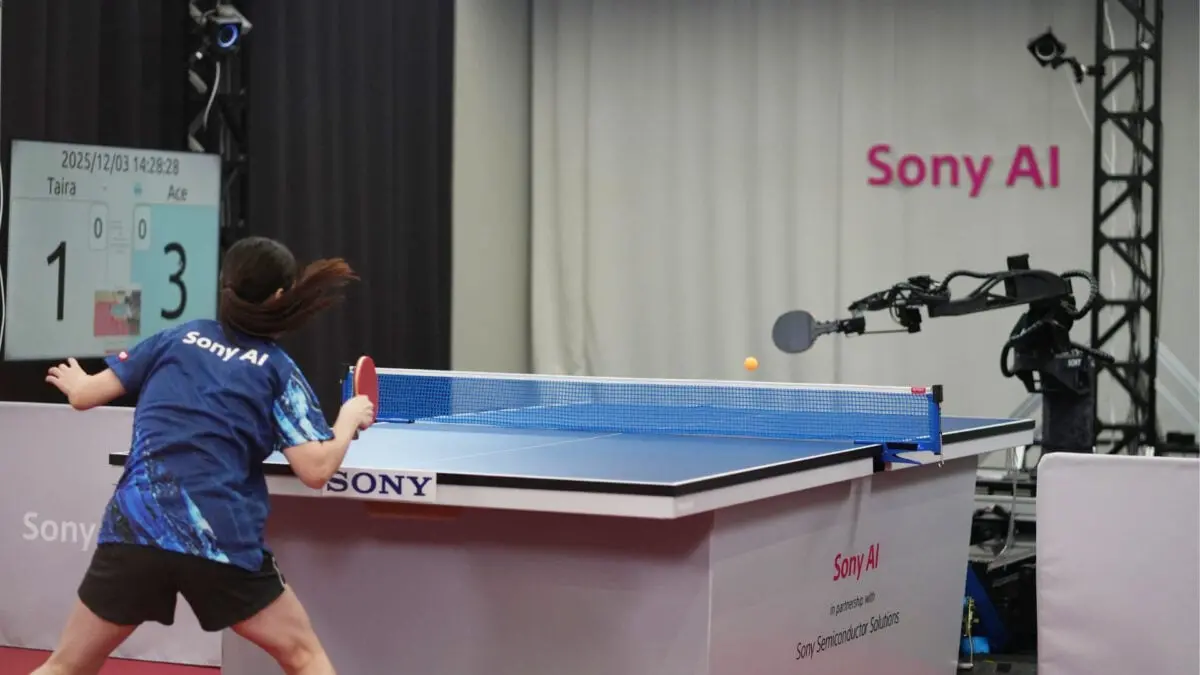
Watch out Marty Supreme, there’s a new contender for the throne of table tennis champ—and it’s not human. Research published today showcases a robot that can match and even best elite human players. Scientists at Sony’s AI division developed the autonomous robotic system, dubbed Ace. Their study details how Ace won a majority of its matches against table tennis players with extensive experience, though it came up short against professional athletes in initial tests. Novelty aside, the software and hardware that makes the robot possible could have many other uses, its creators say.
“The results of our work on Ace highlight the potential of physical AI agents to perform complex, real-time interactive tasks, suggesting broader applications in domains requiring fast, precise human-robot interaction,” lead author Peter Dürr told reporters.
An ace on the court
Systems based on artificial intelligence can now regularly beat people at all sorts of tasks, including various games. Historically, though, it’s been a challenge to design robots smart and nimble enough to surpass humans at physical sports. Table tennis in particular requires fast reaction times and the ability to generate accurate, yet difficult-to-return, high-spin balls to opponents. The sport involves split-second decisions, hand-eye coordination, and the capacity to anticipate an opponent’s next move—a combination that has long eluded roboticists.
Scientists have been tinkering with the possibility of tennis robots since the 1980s, but Ace represents an important step forward for both artificial intelligence and robotics, according to Dürr. “Sony AI conducted this research to study how AI could operate safely and effectively in the physical world, where perception, control, and agility must come together in real time,” he said. “Unlike simulated environments where AI can rely on perfect information, real-world sports like table tennis demand rapid decision-making based on state estimation from noisy sensors and adversarial human interactions.”
Unlike past experiments, the researchers judged Ace’s performance against humans using the actual rules of the International Table Tennis Federation (ITTF); they also recruited licensed umpires to oversee the games. This ensured that the results were both rigorous and comparable to human competitions.
Matches against elite and professional players
In the present study, conducted in April 2025, the researchers paired Ace against five players deemed elite, defined as people who had at least 10 years of playing experience and regularly trained 20 hours a week on average. It also faced off against Minami Ando and Kakeru Sone, two players active in Japan’s professional table tennis league. Ace won three of the five matches against elite players. It won one game against a pro, though it ultimately lost both matches to Ando and Sone. And throughout the matches, the robot displayed agile moves and could consistently serve and return high-speed and high-spin balls. The team’s findings were published Wednesday in the journal Nature.
The researchers didn’t stop there. Ace had another set of matches in December 2025, where it was able to beat both elite and professional players (it won one of the two pro matches). In March 2026, it won three matches against professionals, including Miyuu Kihara, currently a top 25 player in the World Table Tennis rankings for women’s singles. During these matches, Ace displayed improved performance at shooting balls faster and more aggressively closer to the table edge, according to Dürr. The robot’s serve received particular praise, with some human players noting that the spin and placement were difficult to read.
Technical innovations behind Ace
Ace is more than just a robotic arm attached to a table; it is a fully autonomous system integrating computer vision, reinforcement learning, and real-time control. The robot uses multiple high-speed cameras to track the ball’s trajectory, rotation, and speed, then processes that data in milliseconds to plan its return. Its paddle can adjust angle and speed with extreme precision, allowing it to generate top spin, backspin, or sidespin as needed.
The AI was trained using a combination of simulated games and actual play against human opponents. The researchers employed a technique called hierarchical reinforcement learning, where low-level motor skills are learned separately from high-level strategy. This approach allowed Ace to quickly adapt to different playing styles. The system also incorporates a predictive model of the opponent’s likely shot, based on their body posture and paddle movement, giving Ace a competitive edge.
One key challenge was dealing with the latency of physical movement. Even the fastest robot arm has mechanical delays, so Ace’s software had to anticipate where the ball would be before it arrived. The researchers achieved this by using a neural network trained on thousands of ball trajectories. The result is a robot that can return shots with speeds exceeding 50 miles per hour while generating over 100 revolutions per second of spin.
Broader implications for robotics and AI
While the immediate achievement is a sports victory, the technologies developed for Ace have far-reaching potential. Dürr noted that the same real-time perception and control systems could be applied to industrial tasks requiring quick reactions, such as sorting objects on a conveyor belt or performing delicate assembly work. The ability to sense and respond to unpredictable human motions also has implications for collaborative robots, or cobots, that work alongside people in warehouses, hospitals, or homes.
Moreover, the techniques used to train Ace could accelerate progress in other areas of physical AI. For example, the hierarchical learning method could be adapted for autonomous vehicles, which must process sensor data and make decisions in real time. The system’s capacity to handle high-spin dynamics might also benefit research in materials handling or sport training simulators.
The research also addresses fundamental questions about the limits of AI in physical domains. Until now, robots have struggled with tasks that require fine motor control and high-speed adaptation. Ace demonstrates that a machine can learn to compete at a high level in a sport that many consider a benchmark of human agility. This opens the door for further exploration of AI in sports like badminton, tennis, or even baseball pitching.
Historical context and comparison
Previous attempts at table tennis robots date back decades. In the 1980s, Japanese researchers built a robot that could return simple shots, but it lacked the speed and precision to compete with advanced players. In the 2000s, several university projects produced robots capable of rallies with beginners, but none could defeat experienced players. Ace’s success is a culmination of advances in AI, sensing, and actuation. Unlike earlier models that relied on pre-programmed movements, Ace uses machine learning to adapt its play style in real time.
Another notable robot was built by researchers at the University of Tokyo, which could play against humans using a paddle mounted on a gantry system. However, that robot was limited to predictable trajectories and lacked the ability to generate spin. Ace, on the other hand, can vary its shots with side spin and backspin, making it far more challenging.
Sony itself has a history of robotics, from the Aibo dog to the more recent work on humanoid robots. The company’s AI division, established in 2020, has focused on creating intelligent systems that operate in the physical world. Ace is one of the flagship projects, alongside research in gaming AI and autonomous driving.
Future challenges and potential
Despite its improvements, Ace still has weaknesses. It occasionally misjudges slower or heavily spun balls, and its movement is limited to a fixed base, meaning it cannot chase after wide shots. The researchers acknowledge that a fully mobile table tennis robot that could move around the table would be a much harder challenge. They also note that the robot’s performance on a different surface or with different ball types might vary.
The researchers plan to continue refining Ace, perhaps by adding a mobile base or improving its ability to handle serves with extreme spin. They also want to explore how the system can be used in other sports, such as badminton, where shuttlecocks have even more erratic flight paths. The ultimate goal is to create a general-purpose platform for testing physical AI that can be transferred to real-world applications.
As for the human players who faced Ace, many said they found the experience both frustrating and inspiring. “It’s like playing against someone who never gets tired and never makes the same mistake twice,” said Kakeru Sone after his match. Minami Ando remarked that facing the robot forced her to rethink her own strategy, as Ace could counter her signature spin with equal or greater spin. The robot’s ability to learn between games also impressed the professionals, who noted that Ace seemed to get better over the course of a single match.
The researchers believe that Ace is just the beginning. As sensing technology improves and AI algorithms become even more efficient, we can expect to see robots competing in other sports and collaborating more seamlessly with humans. For now, table tennis enthusiasts can marvel at a machine that has earned a place alongside the world’s best players.
Source: Gizmodo News