

Shortwave is still the weirdest and most interesting part of radio
Those signals can travel far enough to feel like they could have come from anywhere
Anyone who's ever used a walkie-talkie or handheld radio knows the deal with VHF and UHF radio. Airband, marine, CB repeaters and radios, and all the devices smartphones have now replaced are all nice and local. So long as your receiver isn't too far away, or blocked by geography, you can pick up a transmission just fine. Shortwave, or HF radio, is a totally different story.
Most of what we call "shortwave" sits in the high-frequency (HF) range, roughly between 3–30 MHz. Signals within that range can travel far further than line-of-sight. Under the right conditions, they hit the ionosphere, refract, and return as "sky waves" as opposed to VHF/UHF "ground waves" that just keep going into space once they fly past the curvature of the earth. They then land hundreds or thousands of miles away. That's why a receiver in California can pick up a transmission that originated in Europe, Africa, or even Australia.
That's also what makes browser SDRs perfect for this kind of weird signal hunting. Instead of buying HAM radio gear for use at home, fighting local conditions, or needing a huge antenna, you can just jump between receivers around the world. If one SDR failed to pick up anything interesting in Germany, you can just jump to another in South Africa, and so on, and try again.
The Buzzer is the obvious place to start
UVB-76 is the longest-running radio mystery and the most reliable signal to start with
The Russian Buzzer, better known as UVB-76, was a bitter disappointment when I first heard it because I expected to hear it transmitting Tchaikovsky's Swan Lake. Instead, I got a repetitive buzzing sound that was dull and irritating. Tune into 4625kHz using Upper Sideband (USB) mode with a KiwiSDR online, and you too can hear it for yourself.
I did find that a lot of SDRs close to the suspected transmission site of the buzzer have blocked out its frequency. This is likely to prevent abuse of the SDR as the frequency is commonly targeted by "radio graffiti" with pirate signals or intentional patterns in the waterfall. What it transmits isn't as important as the reason why it exists in the first place, because we don't actually know. That's the really unsettling and weird part about this particular signal, because it means someone, somewhere, is actively keeping this thing alive.
The station has been tracked since the 1970s, keeps changing callsigns, and sometimes, if you're lucky, the buzzing changes out for some random clips of a Russian voice. It's generally understood to be a Russian military station rather than a mystery signal, but that hasn't stopped the internet from turning it into doomsday folklore. Some believe it is a dead-hand system that would automatically launch nuclear weapons if Russia were destroyed, though there is no evidence for this.
"Skyking, do not answer" belongs to real military shortwave traffic
The phrase is real and can be heard at a few frequencies if you're lucky
The phrase "Skyking, Skyking, do not answer" is legendary online in certain groups and on forums. It is real, and you can hear it if you're listening in on the US High Frequency Global Communications System, or HFGCS, for long enough. The phrase itself means that responding stations shouldn't reply on air, and it was popularized on the internet around 2010 when one of the first publicly accessible webSDRs came online at the University of Twente.
Radio hobbyists explain that the message is a high-priority, encrypted broadcast heard on the HFGCS alongside routine Emergency Action Messages (EAM). I tuned in to several HFGCS frequencies at 4724, 8992, and 11175 kHz, hoping to hear the Skyking broadcast, but only heard test counts, mainsail ground station broadcasts, and aircraft call signs. The HFGCS is used by the United States Air Force to communicate with aircraft, including bombers, tankers, and Air Force One.
These are the signals I tried first
Some are downright creepy, some are useful, and some are just boring
For this experiment, I opened the rx-tx.info SDR map, picked receivers that were currently under nightfall (better for signal propagation), and filtered for HF receivers. I then jumped around between several receivers in different locations and started the hunt for weird signals.
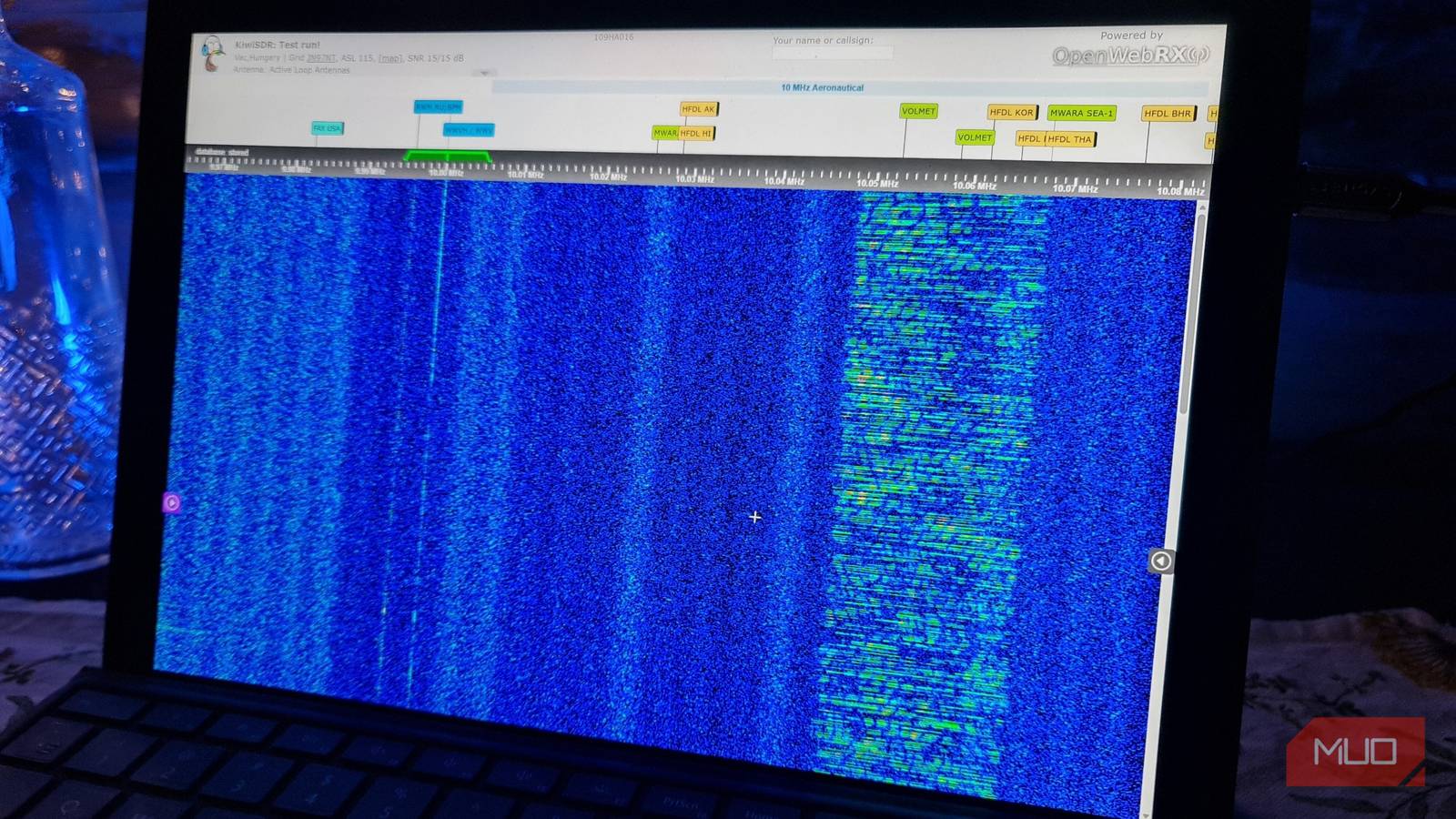
Why use an SDR for this? Because they are located all across the world and feature a constantly scrolling waterfall spectrogram, which is what Shazam and SoundHound use to identify music. That lets you see the signals so you aren't just endlessly scanning noise with your headphones.
Different SDRs tend to have different useful features, and rx-tx.info does make it easier to pick out the best ones:
- Purple = KiwiSDR, which has interesting frequencies already tagged.
- Green = OpenWebRX, typically uses an RTL-SDR receiver, which can get noisy but offers far more custom functionality.
- Blue = WebSDR, which is only given to receivers that have high scientific or research value.
After selecting a few with good signal-to-noise ratio (SNR) and that had visible activity across the HF band, I started tuning into these more well-known signals:
| Signal Name | Frequency | Mode | What to Expect |
|---|---|---|---|
| UVB-76 (The Buzzer) | 4625 kHz | USB | A repeating buzzer that sounds like a ship's horn. Occasionally interrupted by a Russian voice. |
| The Pip | 5448 kHz (day) / 3756 kHz (night) | USB | A repeating pip marker with occasional Russian speech. |
| The Squeaky Wheel | 5367 kHz (day) / 3363.5 kHz (night) | USB | A two-tone high-pitched squeak that quickly gets annoying. |
| HFGCS | 11175, 8992, 4724, 15016 kHz | USB | US military HD voice-only traffic. Mostly silent, but when active you'll hear cool transmissions. |
| HM01 | 065, 9330, 10345, 11435, 11530 kHz | AM (voice & digital data) | Cuban number station with voice groups in Spanish and number groups. |
| E11 / Oblique | Varied schedule | USB | English-speaking number station with woman reading numbers and random phrases. |
| WWV time signal | 2.5, 5, 10, 15, 20 MHz | AM | Spoken time and clock ticks from a US-based time station. |
| CHU Canada | 3330, 7850, 14670 kHz | AM | Canadian time station with spoken announcements. |
The time stations are the boring ones, but they're good practice for spotting other interesting signals on the waterfall because they're consistently broadcasting. Once you get to know what a utility signal looks and sounds like, the genuinely weird signals stand out much more clearly.
Number stations are creepy because they're also really calm
A flat voice reading out codes is so much worse than beeps and static
Number stations are just one of the radio topics where the real explanation is already weird enough without adding the folklore to it. These are shortwave stations that typically broadcast formatted numbers, letters, and code groups in a calm voice that immediately sets off that feeling of unease in listeners.
The common assumption is that these number stations are one-way messages for intelligence assets, but the actual contents aren't publicly available because you and I don't have the corresponding pad or key to decode them. The reality is that many number stations are believed to be operated by intelligence agencies like the CIA, MI6, or the KGB, sending encrypted messages to spies in foreign countries. The voices are often recorded or synthesized, and the broadcasts follow strict schedules.
It's not a futile hobby, though, and active stations like MH01 and E11 are worth chasing. HM01 mixes Spanish voice numbers with digital bursts of data, so it both sounds cool and looks great on the waterfall. E11, commonly known as "Oblique," has more of that classic number-station feel, with English voices reading groups at scheduled times. The Priyom.org website maintains an excellent database of active number stations, their frequencies, and their transmission times.
The routine of it all is what makes it feel so creepy. Out there in the world, there exists a hidden infrastructure of intelligence that you only see one side of. Just weirdly calm voices sending coded numbers into the ionosphere while you sit there wondering who, if anyone, is out there writing them down. The fact that these stations have been operational for decades — some since the Cold War — only adds to the eerie sense of history.
I totally get why people are fascinated by these weird shortwave signals
The real reward is separating the technical utility from the mystery
After spending a few evenings jumping between all the buzzers and military channels, keeping to the number station schedules, and finding some weird digital modes, I really respect the operators who keep their receivers open for use.
There is plenty of folklore around shortwave, from dead-hand stations to haunted frequencies, and the Priyom organization does a fantastic job at cataloging and detailing the schedules for anyone who wants to investigate and hear them firsthand.
For me, the active signals were far more interesting than the old legends. A station I can tune into from the comfort of my home is just way more compelling than reading about creepy recordings from decades ago. But the real fun (and creepy) part of it all was that these signals are still transmitting, still monitored, but only half-explained. The mystery of UVB-76 continues to attract thousands of listeners, and number stations like HM01 and E11 remain active to this day. If you have a few hours to spare, grab a browser-based SDR and start exploring. You never know what you might hear.
Source: MakeUseOf News